Shopping Cart
Jaisalmerwala Food and Sweets
Sub Total:
₹ 0.00
Total:
₹ 0.00
Jaisalmerwala Food and Sweets
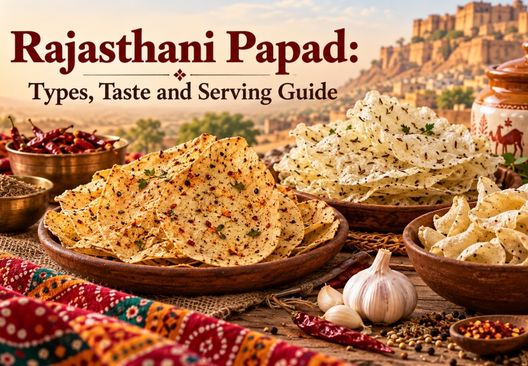
Rajasthani papad includes several traditional dried preparations that differ by flour, seasoning, texture and use. Chana papad offers a pulse-based, savoury crunch; chawal khichiya is known for a lighter rice-based crispness; and rabodi is a dried Rajasthani preparation often cooked in sabzi rather than eaten only as a roasted papad. Choosing between them depends on how you plan to serve them.
Papad and related dried foods have a long place in Rajasthani meals, and regional food references describe rabodi as a papad-like dried preparation traditionally used for cooking.
Rajasthani papad is not one single recipe.
Different regions and households prepare dried papad-style foods using different grains, pulses and spices. Once dried, they become convenient pantry foods that can be roasted, fried or—in some cases—cooked into dishes.
That flexibility is one reason papad feels at home both in an everyday lunch and on a festive thali.
[EXPERT TIP: Before cooking any papad, check its intended use. A crisp papad meant for roasting and a traditional rabodi meant for sabzi should not automatically be treated the same way.]
For a practical introduction, three styles give you very different experiences.
| Variety | Main Character | Common Use |
|---|---|---|
| Chana Lahsun Papad | Savoury, garlic-forward, crisp | Roast/fry and serve with meals |
| Masala Chawal Kheecha | Light, crisp, rice-based style | Roast/fry, snack or meal accompaniment |
| Rabodi Papad | Rustic, dried, traditionally cooked | Sabzi and regional preparations |
These categories are useful because they show that “papad” can mean more than a single thin lentil crisp.
Chana Lahsun Papad brings together the savoury character of chana with the stronger aroma and flavour of garlic.
It suits meals where you want the papad itself to contribute noticeable flavour rather than simply add crunch.
Serve it with:
dal-rice;
roti and sabzi;
khichdi;
a Rajasthani thali;
or as a roasted snack.
Because garlic already provides a strong flavour note, it usually needs very little additional seasoning after roasting.
Chawal khichiya or kheech-style papad is associated with a crisp rice-based style of snack.
Current rice-khichiya products in the market commonly use rice flour as the main base and are served roasted or fried.
The texture is one of its biggest attractions: crisp and light enough to work as a meal accompaniment but interesting enough to eat as a snack.
A masala version adds more seasoning, making it especially useful for:
Rabodi is where the category becomes more interesting.
Educational material on Indian regional cuisine describes Rabodi as a traditional Rajasthani dried preparation resembling small papads, historically prepared using maize flour and buttermilk and then used in cooking.
Another study on traditional foods in Rajasthan describes rabodi as a sun-dried Marwari food used to make curry.
So although shoppers may encounter the term Rabodi Papad, it should not be thought of only as something to roast next to dinner.
Its most distinctive use is Rabodi ki Sabzi.
The biggest difference is purpose.
Regular papad is commonly prepared as a crisp accompaniment.
Rabodi can function more like an ingredient.
Once cooked in gravy, it softens and absorbs the flavour of the spices and sauce, producing an entirely different eating experience.
That makes rabodi useful for anyone who wants to explore Rajasthani cooking beyond the most familiar dishes.
[EXPERT TIP: If you are buying rabodi for the first time, try it in a simple curd- or tomato-based Rajasthani-style gravy rather than judging it only as a dry snack.]
Both methods can work, depending on the product.
With Dal-Rice: Chana Lahsun Papad provides a strong savoury contrast.
With Khichdi: Chawal Kheecha adds crisp texture to a soft meal.
With a Rajasthani Thali: Either crisp style can work, depending on the other flavours on the plate.
For Cooking: Rabodi is the more interesting choice because it can become part of the sabzi itself.
For Snacking: Masala Chawal Kheecha can work well roasted and served directly.
One of the strongest ideas in Rajasthani food is practicality.
The region's cuisine contains several dried preparations that could be stored and later transformed into complete dishes. Rajasthan's arid environment historically influenced the ingredients and food techniques used across the state.
Papad, khichiya and rabodi fit naturally into that story.
They are compact pantry foods, but each provides a different combination of texture, flavour and cooking possibilities.
Keep uncooked papad in a cool, dry place and protect it from moisture.
Always follow the storage and best-before directions on the specific pack, especially after opening.
Moisture can soften dried papad and affect its texture, so resealing the pack properly is important.
If your experience of papad has been limited to the plain crisp served in restaurants, Rajasthani varieties offer much more to discover.
Start with Chana Lahsun Papad when you want a strong savoury flavour, try Masala Chawal Kheecha for a lighter crisp snack, and explore Rabodi when you want to cook a traditional Rajasthani-style dish.
Jaisalmer Wala brings these different pantry traditions together, making it easier to explore them without limiting papad to just one flavour or one way of serving.
The phrase Rajasthani papad covers more variety than it first appears.
Chana papad delivers savoury crunch, chawal kheecha brings a crisp rice-based experience, while rabodi opens the door to a traditional cooked dish.
Explore Jaisalmer Wala's papad range and choose the variety that matches how you like to cook, snack and serve your meals.
There is no single base ingredient. Depending on the variety, traditional papad-style foods can be made from pulses, rice, wheat, maize or other grains and then seasoned and dried.
Chawal kheecha is a rice-based crisp papad-style preparation that can generally be roasted or fried and served as a snack or meal accompaniment.
Not exactly. Rabodi resembles small dried papad pieces but is traditionally used as an ingredient in cooked Rajasthani dishes such as rabodi ki sabzi.
For a straightforward crisp snack, Chana Lahsun Papad or Masala Chawal Kheecha are natural options. Rabodi is better explored as a cooking ingredient.