Shopping Cart
Jaisalmerwala Food and Sweets
Sub Total:
₹ 0.00
Total:
₹ 0.00
Jaisalmerwala Food and Sweets
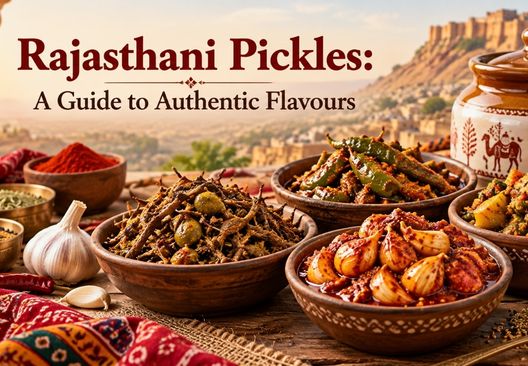
Rajasthani pickles are intensely flavoured condiments built around regional ingredients such as kair, sangri, chillies, garlic and traditional spices. Their flavour can range from sharp and tangy to hot, earthy or deeply savoury. Served in small portions with roti, paratha, dal-rice, or a Rajasthani thali, achar adds contrast and character without dominating the entire meal.
Rajasthan's official tourism information identifies Ker Sangri as one of the state's authentic preparations and explains that ker is a desert shrub berry while sangri comes from the Khejri tree.
Rajasthani cuisine developed under conditions where water and fresh vegetables were historically less abundant than in many wetter regions.
The Rajasthan Foundation notes that the state's arid conditions influenced ingredient availability and helped shape a cuisine built around grains, gram flour, dairy and foods suited to the region.
Pickles fit naturally into this style of eating.
They add flavour to simple meals, pair easily with dry breads and travel well as an accompaniment when properly prepared and stored.
[EXPERT TIP: Think of achar as a flavour accent rather than a side dish you need in large quantity. A small serving can completely change a simple roti, paratha or dal-rice meal.]
There is no single “Rajasthani pickle flavour.”
The experience changes dramatically depending on the main ingredient.
| Pickle Style | Typical Flavour Direction | Good Pairing |
|---|---|---|
| Kair Sangri Achar | Tangy, earthy, spiced | Bajra roti, paratha, dal |
| Kair Achar | Sharp, regional, savoury | Roti, khichdi |
| Kair Methi Achar | Tangy with a mildly bitter-spiced edge | Paratha, dal-rice |
| Laal Mirch Achar | Bold and chilli-forward | Plain paratha, curd-rice combinations |
| Athana Mirchi Achar | Spicy, punchy | Roti, poori, meals needing extra heat |
| Lahsun Achar | Savoury and garlic-forward | Dal, paratha, simple sabzi |
| Lahsun Chutney Achar | Strong garlic and spice character | Bajra roti, snacks, thali |
Exact flavour varies by recipe, spice balance and preparation.
Kair and sangri are among the ingredients most strongly associated with the desert food culture of Rajasthan.
Rajasthan Tourism describes ker sangri as a combination of ker berries and sangri from the Khejri tree, traditionally cooked with spices and known for a tangy, flavourful character. It is also associated with Marwari wedding meals.
Turning that flavour profile into achar gives buyers another way to enjoy the regional ingredients.
Kair Sangri Achar works especially well when the main meal itself is simple.
Try it with:
bajra or wheat roti;
stuffed or plain paratha;
dal and rice;
khichdi;
or a full Rajasthani-style thali.
The names sound similar, but the eating experience is different.
Kair Achar puts kair at the centre of the flavour.
Kair Sangri Achar combines kair with sangri, giving the pickle a more varied texture and a stronger connection to the classic ker-sangri pairing associated with Rajasthan.
If you enjoy regional ingredients and want more texture, kair sangri is a natural option. If you want the flavour of kair itself to stand out more clearly, kair achar may suit you better.
Garlic has a strong savoury flavour that works particularly well with dry breads and simple lentil dishes.
A garlic-forward achar can add depth to:
Bajra roti: where its intensity contrasts with the earthy grain.
Paratha: where it works as an instant accompaniment.
Dal: where a small serving adds a sharper flavour dimension.
Khichdi: where it cuts through the mildness of the dish.
This is also why garlic chutney is so closely associated with Rajasthani meal combinations; Rajasthan Tourism lists spicy garlic chutney alongside dal-bati-churma.
If chilli is what you want, consider how intense you want the accompaniment to feel.
Laal Mirch Achar is a natural fit for people who enjoy a bold chilli-led taste.
Athana Mirchi Achar offers another traditional chilli-pickle style for meals where you want a stronger spicy accent.
Rather than asking which is “better,” choose based on the dishes you normally eat and your preferred heat level.
[EXPERT TIP: When trying a new chilli pickle, start with a small portion. Heat and salt perception vary widely between recipes and individual taste.]
Achar usually works best when it supports the meal rather than overpowering it.
A spoonful can be enough alongside:
Add pickle with curd for a quick, strongly flavoured accompaniment.
A tangy or spicy achar provides contrast to softer, milder flavours.
Pickle adds bite and intensity to a simple comfort-food meal.
Use different pickles in small portions to create variation across bites.
Storage instructions should always follow the information printed on the specific product pack.
As a general kitchen habit, use a clean, dry spoon, close the container properly after use and avoid introducing unnecessary moisture into the jar.
The manufacturer's label should remain your primary guide for shelf life and storage conditions.
For many shoppers, “Indian pickle” immediately means mango or lime.
Rajasthan offers a much wider flavour vocabulary.
Ingredients such as kair, sangri, garlic and regional chillies allow people outside Rajasthan to experience food combinations that are closely connected with the state's landscape and culinary traditions.
That is also where Jaisalmer Wala's achar range becomes interesting: instead of offering only one familiar pickle, it gives buyers the chance to explore different regional flavour profiles.
The best way to explore Rajasthani pickles is not to search for one universal “best achar.” Each variety plays a different role.
Choose Kair Sangri Achar for a distinctly regional combination, Lahsun Achar for garlic-forward intensity, or Mirchi Achar when you want heat to lead the flavour.
Explore the Jaisalmer Wala achar collection and build your own combination around the meals you already enjoy.
Many Rajasthani pickles use ingredients and flavour combinations closely associated with the region, including kair, sangri, chillies, garlic and robust spice blends.
Kair is a desert shrub berry and sangri comes from the Khejri tree. Together they form one of Rajasthan's best-known traditional food combinations.
Garlic achar, mirchi achar, kair achar and kair sangri achar can all pair well with paratha. The best choice depends mainly on whether you prefer spicy, tangy, savoury or earthy flavours.
Follow the storage directions on the product label, keep the container properly closed and use a clean, dry spoon to avoid introducing moisture.